
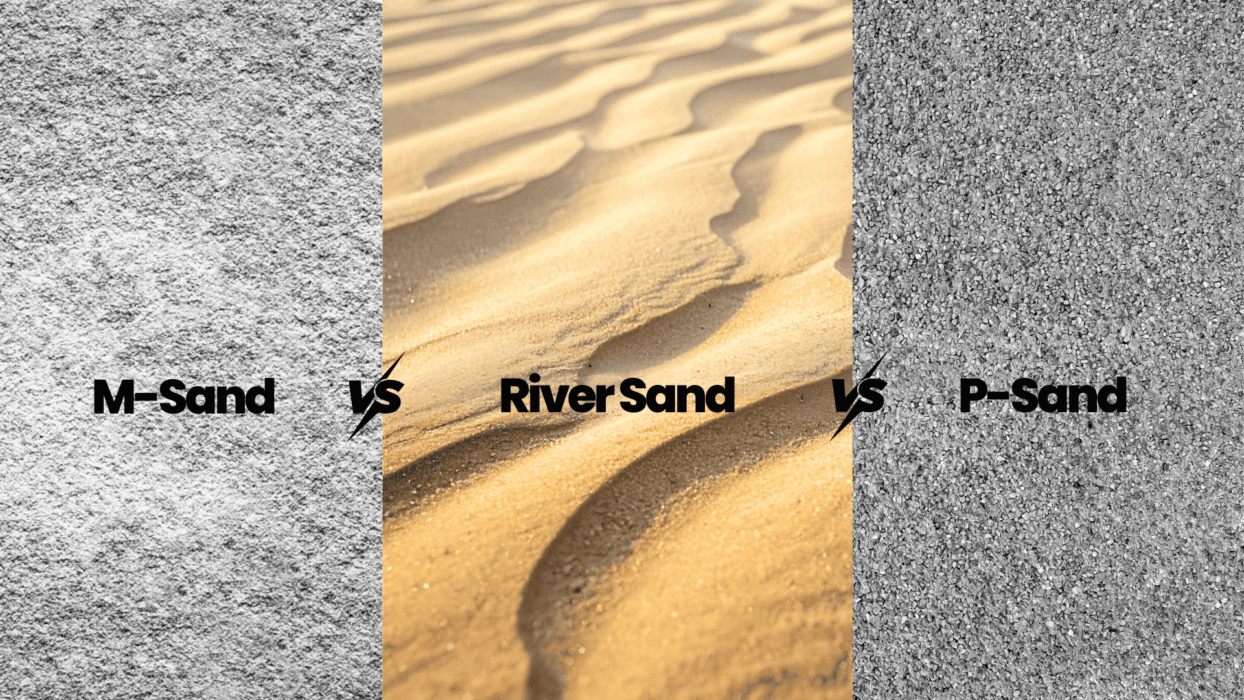
Choosing the Right Sand: River Sand vs. M-Sand vs. P-Sand
In the world of construction, “sand” isn’t just one material. It is the essential “fine aggregate” that binds with cement and water to create the backbone of our homes and infrastructure.
If you are planning a renovation or building a new home, you’ve likely heard your contractor mention River Sand, M-Sand, and P-Sand. While they may look similar at a glance, using the wrong type in the wrong place can compromise the strength and finish of your project.
1. River Sand (The Traditional Choice)
River sand is a natural product formed by the weathering of rocks over centuries, collected from riverbeds. It has been the go-to material for decades due to its accessibility and natural properties.
- Characteristics: It has rounded, smooth particles because of the natural erosive action of water.
- Best Used For: General construction and concrete work.
- Pros: It is easy to work with and contains fewer voids, meaning it requires less water when mixing.
- Cons: It often contains impurities like clay, shells, and organic matter that must be washed out. More importantly, heavy mining of riverbeds causes significant environmental damage, leading many regions to ban or strictly regulate its use.
2. M-Sand (Manufactured Sand)
As river sand became scarce and environmentally costly, Manufactured Sand (M-Sand) emerged as the superior alternative. It is produced by crushing hard granite rocks into fine particles.
- Characteristics: The particles are angular and have a rougher surface texture compared to river sand.
- Best Used For: All types of structural work, including high-strength concrete, beams, columns, and foundations.
- Pros:
- Purity: Since it is manufactured in a controlled environment, it is free from silt and organic impurities.
- Strength: The angular shape provides a better “interlocking” bond with cement, leading to stronger structures.
- Eco-Friendly: It reduces the need to dredge riverbeds.
- Cons:
- It can be slightly harsher to work with than smooth river sand, requiring precise water-to-cement ratios.
3. P-Sand (Plastering Sand)
P-Sand is a specialized version of M-Sand specifically designed for finishing work. While structural M-Sand is coarse, P-Sand is processed to be much finer.
- Characteristics: It is exceptionally fine and usually passed through a series of sieves (specifically a 150-micron sieve) to ensure a powdery consistency.
- Best Used For: Internal and external wall plastering and brickwork.
- Pros: It gives walls a smooth, crack-free finish. Because it is highly refined, it reduces the “rebound loss” (sand falling off the wall) during the plastering process.
- Cons: It cannot be used for structural concrete because its particles are too fine to provide the necessary strength for heavy loads.
Quick Comparison Table
| Feature | River Sand | M-Sand (Crushed) | P-Sand (Plastering) |
|---|---|---|---|
| Origin | Natural (Riverbeds) | Factory (Crushed Granite) | Factory (Finely Crushed) |
| Shape | Rounded / Smooth | Angular / Rough | Very Fine / Granular |
| Silt Content | High (Needs washing) | Zero / Minimal | Zero |
| Strength | Moderate | Very High | Low (Not for load-bearing) |
| Primary Use | Concrete & Masonry | Foundations, Beams, Slabs | Wall Plastering |
Which one should you choose?
The modern industry standard is moving toward a hybrid approach. For the “skeleton” of your house (the foundation, pillars, and roof), M-Sand is the most reliable and cost-effective choice. For the “skin” of your house (the walls), P-Sand ensures a beautiful, smooth finish that requires less paint.
By choosing manufactured sands, you aren’t just getting a more consistent product; you’re also making a greener choice for the planet.
Would you like me to calculate the estimated quantity of sand you might need based on your project’s square footage?